Homes & businesses · North East England
Electrical waste disposal & WEEE recycling
Old appliances, unwanted computers or a stockroom full of broken electricals? GRIDCO arranges electrical waste disposal across Newcastle, Northumberland and Teesside, with the right collection route for your equipment and clear paperwork for your records.
Request an electrical waste collection quote · Call 0191 323 5082 · Send your WEEE photos on WhatsApp
Included with our waste services
Every job includes a waste transfer note.
Commercial customers also receive a waste report every month.
Looking for electrical waste disposal near me?
If you are searching for electrical waste disposal near me, start with a service that can confirm your postcode, the items you have and the treatment they need. GRIDCO is based in Blyth, Northumberland, and arranges collections through registered waste carriers and appropriately authorised waste facilities; we do not operate a public drop-off centre.
Our core service area covers Newcastle upon Tyne, Blyth, Cramlington, Ashington, Bedlington, Morpeth, Ponteland, Hexham and surrounding Northumberland communities. We also arrange collections in Teesside, including Middlesbrough, Stockton-on-Tees, Hartlepool, Darlington, Redcar and Yarm. Availability depends on your postcode, equipment and access, so contact us before making arrangements.
For a useful quote, send photographs, an item list, quantities and your postcode. Tell us about stairs, lifts, parking and whether anything is damaged. We will confirm the collection requirements and price before you book, rather than treating every electrical item as the same waste stream.
What is electrical waste, and what does WEEE mean?
WEEE means waste electrical and electronic equipment. It includes discarded equipment that needs electricity or batteries to work, from a kettle or printer to a fridge or computer monitor. The crossed-out wheelie bin symbol is a reminder that electrical equipment should be collected separately rather than put into general rubbish.
Electrical waste disposal is not simply throwing an appliance away. Depending on its condition and classification, the correct route may involve reuse, specialist treatment, recovery of suitable materials or disposal of hazardous components. Not all WEEE is recyclable: equipment containing persistent organic pollutants above the relevant limits needs a controlled destruction route, not ordinary recycling.
Electrical items we can help arrange collections for
Tell us exactly what you need removed so we can check acceptance and arrange the correct operator. The following are common enquiry types, not a promise that every item is accepted on every collection.
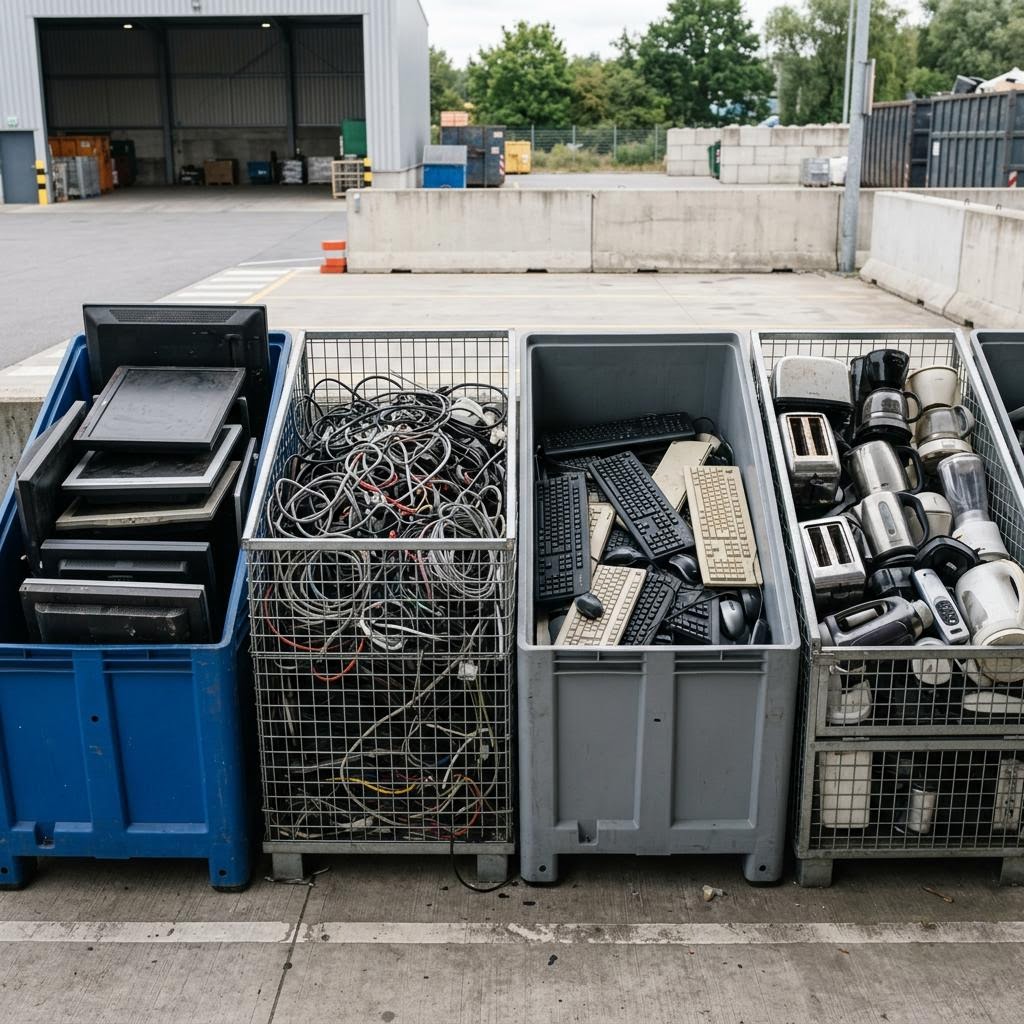
- Computers and office IT: desktops, laptops, printers, keyboards, network equipment and related electricals.
- Screens and entertainment equipment: televisions, monitors, audio equipment and games consoles, with classification checked before collection.
- Large appliances: washing machines, dishwashers, electric cookers and tumble dryers. Heat-pump dryers require different handling from conventional dryers.
- Fridges, freezers and cooling equipment: declare these separately because refrigerants and insulation can require specialist treatment.
- Small electrical appliances: kettles, toasters, vacuum cleaners, microwaves and other unwanted household electricals.
- Business equipment: electrical tools, shop and office equipment, subject to the item type, quantity and collection requirements.
- Lamps and batteries: identify fluorescent tubes, lamps and loose or damaged batteries separately; do not mix them into a general WEEE load without agreement.
Electrical waste disposal rules in England
The rules below apply to England, including our North East service area. Scotland, Wales and Northern Ireland have their own regulatory guidance. This is a practical overview, not a substitute for advice on your particular waste.
For households, keep unwanted electricals out of general rubbish and mixed recycling bins. Check your council's household recycling centre rules, any booking or residency requirements, and the retailer's take-back arrangements when replacing equipment. Free recycling or take-back options may exist, but this does not mean a collection from your property is free. Business waste must not be passed off as household waste.
Businesses have a legal duty of care. Classify electrical waste before it leaves the premises, store it securely, check the carrier's registration and make sure the receiving site is authorised for that waste. Equipment used for a business at home is still business waste. A household recycling centre may not accept it, or may operate a separate paid trade-waste service.
Use the correct movement paperwork. A waste transfer note records non-hazardous waste movements; hazardous WEEE may require a hazardous waste consignment note. Every GRIDCO job includes a waste transfer note, with the legally required consignment documentation arranged where applicable. A transfer note does not replace a required hazardous waste consignment note.
- Do not put electrical equipment in a mixed general-waste skip unless the provider has explicitly agreed a suitable separate WEEE arrangement.
- Do not break up fridges, puncture refrigerant circuits or smash screens to make a collection easier.
- Keep batteries and lamps identified and protected from damage; ask for advice on damaged or swollen batteries before moving them.
- Check registration details using the Environment Agency public register, rather than relying on a low price or a verbal assurance.
- Describe the actual equipment and its condition accurately so the correct classification, transport and treatment can be arranged.
Is electrical waste hazardous?
Some electrical waste is hazardous and some is not. Fridges and freezers, certain screens, fluorescent tubes and equipment containing hazardous components need careful classification. The Environment Agency also identifies heat-pump tumble dryers as hazardous because of their coolants, unlike conventional vented and condenser dryers.
Persistent organic pollutants, often called POPs, can occur in plastics and other components. If the relevant limits are exceeded, the equipment cannot follow a normal reuse or recycling route. We ask about equipment types and condition so the arranged operator can identify the appropriate treatment; we do not assume that a working-looking device is safe to recycle.
Do not remove built-in batteries or dismantle equipment unless it is designed for safe user removal. If a battery is swollen, leaking, hot or damaged, stop using the device and seek specialist advice. Tell us before booking; ordinary collection arrangements may not be suitable.
Business WEEE disposal, office clearances and data security
Office moves, IT refreshes, retail refits and equipment failures can leave a mixture of electrical waste that needs more than a general rubbish collection. Give us an inventory covering equipment types, quantities, asset labels where relevant and any separate hazardous items. We can then arrange a suitable collection plan without confusing household and commercial waste routes.
Computers, phones, printers and storage devices may retain personal or commercially sensitive information. Back up anything you need and arrange secure data erasure or physical destruction before equipment is released. A normal WEEE collection and a waste transfer note are not proof of data destruction. Tell us in advance if you need a specialist data-security service and agree the method and evidence before booking.
Every job includes a waste transfer note. Every commercial customer also receives a waste report every month. Where your load requires additional hazardous-waste documentation, this must accompany the relevant movement. Keep waste paperwork and any separately agreed data-destruction evidence with your business records.
How much does electrical waste disposal cost?
There is no reliable one-price answer for every WEEE collection. The quote depends on item types, quantity, weight or volume, your postcode, access, loading requirements and the treatment route. A few small electricals are different from an upstairs office clearance or a load containing cooling appliances.
Send an item list and photographs to help avoid unexpected charges. Mention fridges, freezers, monitors, lamps, batteries and any damaged equipment separately. We confirm the agreed scope and collection arrangements before you commit. We do not advertise a blanket free collection or guaranteed same-day service.
If you only have one small household item, a council electrical recycling point or a retailer take-back scheme may be more suitable than a paid collection. Check local acceptance rules first. GRIDCO is useful when you need collection arranged from your premises, several waste streams coordinated or help understanding the right route.
How to prepare for an electrical waste collection
A little preparation helps the operator arrive with the right plan. Do not disconnect fixed wiring, gas connections or specialist equipment yourself unless qualified. Arrange safe disconnection by a suitable professional before removal, and tell us if an appliance is still connected.
- List the electrical items and quantities; photograph larger loads and anything unusual.
- Share your postcode, preferred date, floor level, lift access, parking and any loading restrictions.
- Identify cooling appliances, screens, lamps and batteries separately, including damaged equipment.
- Back up and securely deal with personal data; confirm any specialist destruction requirements in advance.
- Keep equipment dry, secure and separate from other waste. Do not leave electricals on the pavement for an unconfirmed collection.
- Wait for confirmation of acceptance, price and collection arrangements, and retain the paperwork after the job.
What happens to your electrical waste after collection?
The arranged carrier takes the agreed items through an appropriate authorised route. Depending on the classification, treatment may include removing hazardous components, separating suitable metals and other materials, or controlled destruction of POPs-containing parts. Reuse is only appropriate where the item is suitable and the legal requirements are met.
We prioritise the correct route over claims that every load is recycled. GRIDCO coordinates the service through independent operators; we do not own a recycling plant or promise a universal recycling percentage. Your waste transfer note and any required consignment documentation support a clear record of the movement.
Electrical waste disposal FAQs
Where can I dispose of electrical waste near me?
Households can check council electrical recycling facilities and retailer take-back arrangements. For a collection from your property, GRIDCO arranges WEEE services across Newcastle, Northumberland and Teesside, subject to your postcode and equipment. We are not a public drop-off centre.
Can electrical waste go in the normal bin?
Keep electrical equipment separate from general rubbish and mixed recycling. Batteries and electrical components can create fire and pollution risks. Use an appropriate electrical recycling, take-back or specialist collection route instead.
What are the electrical waste disposal rules for businesses?
In England, classify the equipment, store it safely, check the waste carrier's registration and use an authorised receiving facility. Keep the correct movement paperwork: a transfer note for non-hazardous waste and consignment documentation where required for hazardous WEEE.
Is WEEE collection free?
Not necessarily. Some household recycling and retailer take-back options are free, but a collection from your premises may be chargeable. GRIDCO quotes according to the equipment, quantity, postcode, access and treatment requirements; we do not promise free collections.
Can you arrange fridge and freezer disposal?
Contact us with the appliance type, quantity, postcode and access details. Cooling equipment needs a specialist route because of refrigerants and other components. Acceptance and collection arrangements must be confirmed in advance.
Are all electrical items hazardous waste?
No. Classification depends on the item and its components. Some screens, cooling appliances, fluorescent lamps and other equipment require hazardous-waste controls. POPs-containing waste may need controlled destruction rather than normal recycling.
Can I put electrical items in a skip?
Do not put WEEE into a mixed general-waste skip. Ask the provider to confirm a suitable separate electrical-waste arrangement first, especially for fridges, monitors, lamps and batteries.
Does computer disposal include secure data destruction?
Do not assume it does. Standard electrical-waste collection and waste paperwork are not evidence of data destruction. Ask about a specialist service and agree the method and evidence before booking; back up needed information first.
Will I receive waste paperwork?
Every GRIDCO job includes a waste transfer note, and commercial customers receive a waste report every month. Legally required hazardous waste consignment documentation is arranged where applicable; a transfer note does not replace it.
Do you collect electrical waste from homes as well as businesses?
GRIDCO arranges both household and business electrical waste collections across its North East service area. Send your postcode, item list, photographs and access details so acceptance, availability and price can be confirmed.
Official guidance and useful checks
England-specific guidance. Check the linked official sources for updates and advice on your particular waste.
Arrange your electrical waste collection
Send your postcode, item list, photographs and access details. GRIDCO confirms the price, acceptance and availability before booking.
Request an electrical waste collection quote · Call 0191 323 5082 · Send your WEEE photos on WhatsApp
Frequently asked questions
Where can I dispose of electrical waste near me?
Households can check council electrical recycling facilities and retailer take-back arrangements. For a collection from your property, GRIDCO arranges WEEE services across Newcastle, Northumberland and Teesside, subject to your postcode and equipment. We are not a public drop-off centre.
Can electrical waste go in the normal bin?
Keep electrical equipment separate from general rubbish and mixed recycling. Batteries and electrical components can create fire and pollution risks. Use an appropriate electrical recycling, take-back or specialist collection route instead.
What are the electrical waste disposal rules for businesses?
In England, classify the equipment, store it safely, check the waste carrier's registration and use an authorised receiving facility. Keep the correct movement paperwork: a transfer note for non-hazardous waste and consignment documentation where required for hazardous WEEE.
Is WEEE collection free?
Not necessarily. Some household recycling and retailer take-back options are free, but a collection from your premises may be chargeable. GRIDCO quotes according to the equipment, quantity, postcode, access and treatment requirements; we do not promise free collections.
Can you arrange fridge and freezer disposal?
Contact us with the appliance type, quantity, postcode and access details. Cooling equipment needs a specialist route because of refrigerants and other components. Acceptance and collection arrangements must be confirmed in advance.
Are all electrical items hazardous waste?
No. Classification depends on the item and its components. Some screens, cooling appliances, fluorescent lamps and other equipment require hazardous-waste controls. POPs-containing waste may need controlled destruction rather than normal recycling.
Can I put electrical items in a skip?
Do not put WEEE into a mixed general-waste skip. Ask the provider to confirm a suitable separate electrical-waste arrangement first, especially for fridges, monitors, lamps and batteries.
Does computer disposal include secure data destruction?
Do not assume it does. Standard electrical-waste collection and waste paperwork are not evidence of data destruction. Ask about a specialist service and agree the method and evidence before booking; back up needed information first.
Will I receive waste paperwork?
Every GRIDCO job includes a waste transfer note, and commercial customers receive a waste report every month. Legally required hazardous waste consignment documentation is arranged where applicable; a transfer note does not replace it.
Do you collect electrical waste from homes as well as businesses?
GRIDCO arranges both household and business electrical waste collections across its North East service area. Send your postcode, item list, photographs and access details so acceptance, availability and price can be confirmed.
Share this article
LinkedIn · Facebook · WhatsApp · X · Message
Article link: https://gridcowastemanagement.com/electrical-waste-disposal