GRIDCO Resources · Business waste update
Waste rules are changing: a simple timeline for businesses
Waste rules are changing, but the dates do not apply to every business in the same way. Use this timeline and five-minute checklist to see what may affect your workplace, what is already in force and what to verify next.
By GRIDCO Waste Management ·
Waste rules are changing—but not all at once
Many businesses have heard that waste rules are changing, but are unsure which dates matter to them. The answer depends on what your business does, how many full-time equivalent employees it has, where each site is located and whether you produce or handle regulated packaging or drinks containers.
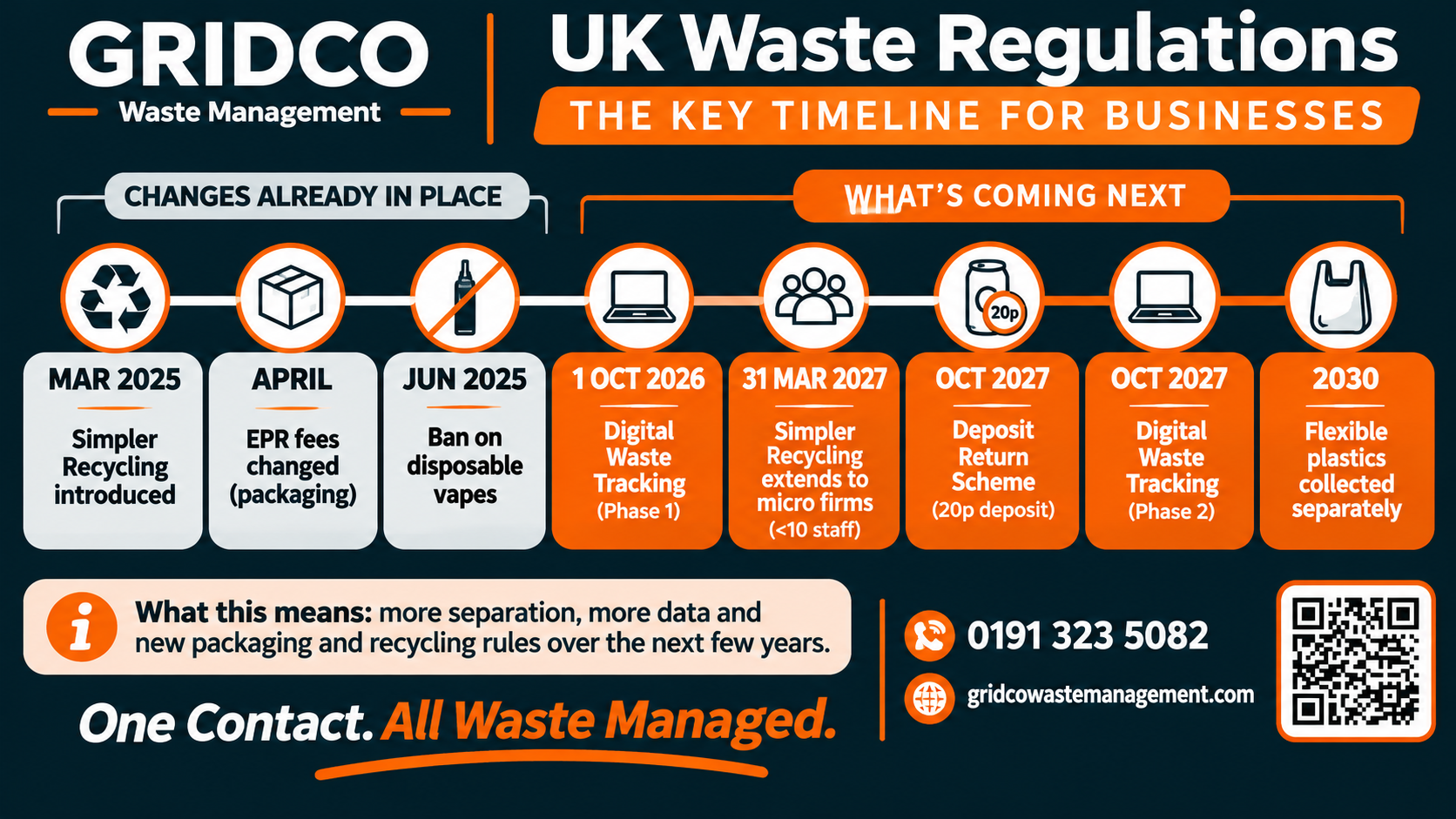
This guide focuses mainly on workplaces in England. Some schemes operate across parts of the UK, while Scotland, Wales and Northern Ireland have separate rules or timetables. Use the infographic as a prompt to check your own situation, then confirm details against the current government guidance.
Changes already in place
Simpler Recycling workplace rules came into force in England on 31 March 2025 for most workplaces. They require separate arrangements for dry recyclable materials, food waste and residual (general) waste. Micro-firms with fewer than 10 full-time equivalent employees have until 31 March 2027. The employee count is across the business, not calculated separately at each site; use the official guidance for how part-time hours are counted and which exemptions apply.
Packaging Extended Producer Responsibility (EPR) is already affecting obligated producers. Who must report and pay depends on the type and amount of packaging supplied or imported and the organisation’s turnover. Modulated fees take account of packaging recyclability, but many businesses that are not directly obligated may still see supply-chain effects. Check your own status rather than assuming that every business has the same duties.
The sale and supply of single-use vapes has been banned across the UK since 1 June 2025. Used vapes contain batteries and should be kept out of general waste; arrange an appropriate battery or electrical-waste route.
Digital waste tracking is being introduced in phases
The infographic marks 1 October 2026 as a digital waste tracking milestone and October 2027 as a later phase. Government plans describe a phased move towards mandatory digital waste tracking across the UK, but which organisation must use the service—and when—depends on the latest implementation rules and the organisation’s role.
Do not assume the same date applies to every waste producer, receiving site, carrier, broker or dealer. Nor should you assume that digital records replace every existing document immediately. Check the current government timeline for the specific duty that applies to your business and keep following existing transfer-note and record-keeping requirements unless official guidance says otherwise.
Deposit Return Scheme: prepare for the containers in scope
GOV.UK currently states that the Deposit Return Scheme starts on 1 October 2027 in England and Northern Ireland. The scheme applies to certain single-use drinks containers made mainly from aluminium, steel or PET plastic, between 150 millilitres and 3 litres. Producers and retailers have different registration, labelling, charging and return-point responsibilities.
The infographic shows a 20p deposit, but the current GOV.UK producer and retailer guidance says the deposit management organisation will set the amount. Treat the figure in the image as illustrative, not a confirmed charge. Scotland has separate legislation and guidance; check the relevant scheme rules for each nation where you sell drinks.
Flexible plastics: check the collection timetable for your site
The infographic uses 2030 as a marker for separate flexible-plastic collections. Do not treat that date as a universal deadline for every UK business or household. Collection duties, material definitions and commencement dates depend on the rules in force for the nation, sector and collection scheme.
If your business generates large amounts of film, bags or shrink-wrap, ask your waste provider what can be separated now, what material specifications apply and how the collection will be documented. Review the official guidance again before planning around a future deadline.
Your five-minute business checklist
Work through these questions for every site. If you are unsure about a legal duty, confirm it with the relevant regulator or a suitably qualified adviser.
- How many full-time equivalent employees does the business have across all its sites? If you may qualify as a micro-firm, check the official counting rules and 31 March 2027 deadline.
- Are dry recyclables, food waste and residual waste separated as required for your workplace?
- Does your business produce food waste, including from staff kitchens? Ask your collector to confirm the right separate arrangement.
- Do you produce or import packaging, or sell in-scope drinks containers? Check whether EPR or Deposit Return Scheme producer or retailer duties apply to your role.
- Have you checked your waste carrier and destination, and do you retain the correct waste transfer or consignment records?
- Are vapes, batteries and electrical equipment kept out of general waste and sent through an appropriate route?
- Do you produce flexible film or shrink-wrap? Ask which collections are available now and check the latest timetable for your nation and sector.
Why getting waste arrangements right matters
Good separation helps prevent contamination, makes suitable recycling and recovery routes easier to identify, and gives your team clearer records. It can also reveal whether you are paying for collections that do not match the waste your business actually produces. Savings are not guaranteed; costs depend on the waste stream, location, containers and collection schedule.
Businesses also have a duty of care for waste they produce. Keep accurate descriptions and records, use appropriately authorised waste services and ask where the material is going. A new tracking system does not remove the need to understand your responsibilities.
How GRIDCO can help
GRIDCO is an independent waste management broker based in Blyth. We can review your waste streams, check suitable services with licensed operators and help arrange collections for dry recycling, food waste, general waste and specialist streams across the North East. We do not own waste facilities or certify legal compliance.
Request a free GRIDCO Waste MOT to discuss your site and current arrangements. It is a no-obligation site visit, not a statutory audit or compliance certificate. Tell us what you produce, where it is collected and what you would like to improve; we will review suitable options and confirm availability and pricing.
Official sources
- GOV.UK: Simpler Recycling workplace rules in England
- GOV.UK: developing the digital waste tracking service
- GOV.UK: Deposit Return Scheme responsibilities for drinks businesses
- GOV.UK: check whether your business must comply with packaging EPR
- GOV.UK: report packaging data
- GOV.UK: single-use vape ban information for businesses
- GOV.UK: managing your business waste and duty of care
Related guides and services
Request a free GRIDCO Waste MOT · More Resources
Frequently asked questions
Does Simpler Recycling apply to every business in England?
Most workplaces in England must separate dry recyclables, food waste and residual waste. Micro-firms with fewer than 10 full-time equivalent employees have until 31 March 2027. Check the official guidance for employee counting and exemptions.
Does the 10-employee threshold apply separately to each location?
No. The micro-firm threshold is based on the total workforce across the business, not a separate count at each site. Follow GOV.UK's current rules for calculating full-time equivalent employees.
Is the Deposit Return Scheme deposit definitely 20p?
Do not rely on the 20p figure in the infographic. Current GOV.UK guidance says the deposit management organisation will set the amount. Check the official scheme guidance for the latest confirmed value and responsibilities.
Does digital waste tracking start on the same date for everyone?
No single date should be assumed for every waste producer, receiving site, carrier, broker or dealer. The system is being introduced in phases; check current government guidance for your role, nation and the latest commencement dates.
Does the 2030 flexible-plastics date apply to every UK business?
Do not assume that it does. The infographic's 2030 marker is a planning prompt; requirements and dates can depend on the nation, sector, material and rules in force. Ask your collector and check current official guidance.
Can GRIDCO certify whether my business is compliant?
No. GRIDCO can review your collections and help arrange suitable waste services through licensed operators, but a Waste MOT is not a statutory audit or compliance certificate. Seek advice from the relevant regulator or a qualified adviser for legal determinations.
Share this article
LinkedIn · Facebook · WhatsApp · X · Message
Article link: https://gridcowastemanagement.com/resources/waste-rules-business-timeline